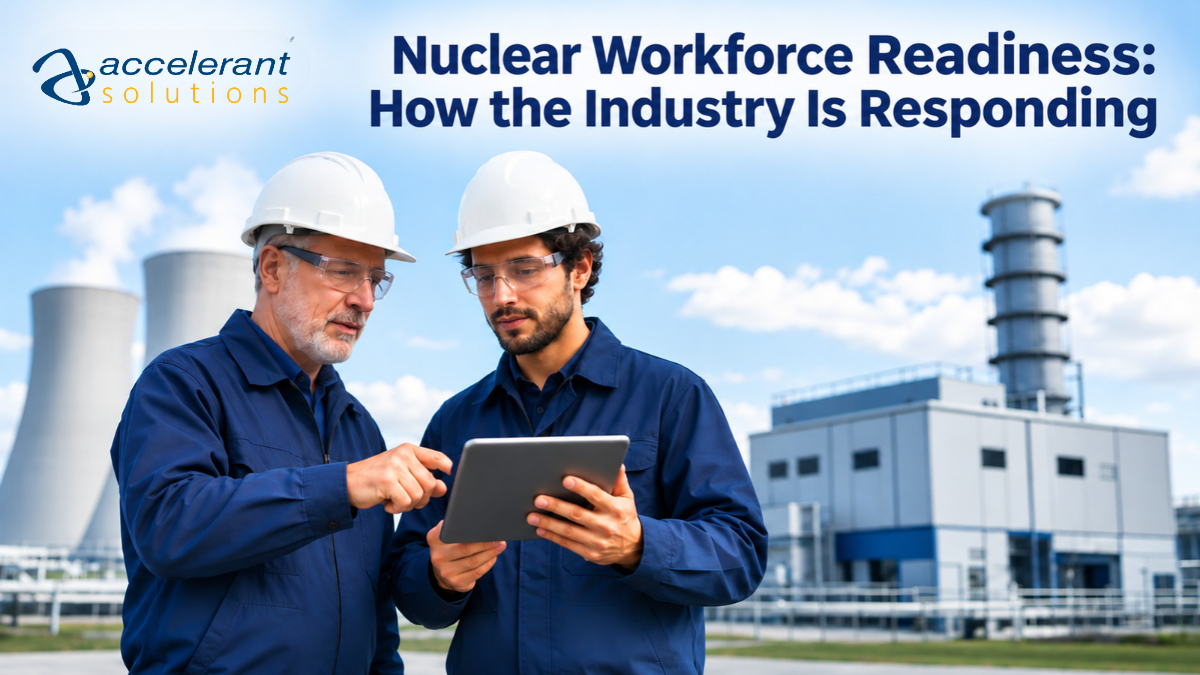
Nuclear Workforce Readiness: How the Industry Is Responding
After more than 30 years in nuclear power, I have watched the industry move through expansion, contraction, and now a renaissance. Technology stories naturally get the headlines: restarts, uprates, SMRs, and microreactors. However, what I hear in control rooms and supplier meetings is quieter and more urgent. Who is going to run, maintain, build, and oversee these plants? That question is at the heart of nuclear workforce readiness.
Three pressures are converging on the same talent pipeline, making nuclear workforce readiness a priority. Retirements are taking experienced people out of the industry, data centers are drawing from the same skilled trades, and restarts and new builds are creating demand for more qualified workers. Together, those pressures explain why the industry is already changing how it recruits, trains, and passes on operating experience.
1. An Aging Workforce and the Knowledge That Walks Out the Door
First, an aging workforce means critical knowledge is walking out the door. Department Of Energy workforce reporting shows nuclear trending older than other energy sources. Specifically, their 2024 analysis found that 60% of nuclear workers were ages 30 to 54. This is higher than the wider energy workforce. Furthermore, nuclear had 23% fewer workers under the age of 30 compared to the overall energy workforce. As the DOE noted, this gap means “a significant chunk of the nuclear workforce is likely to retire over the next decade.”
Retirements are not just a headcount problem. They are a knowledge problem. The people leaving carry decades of operating experience and unwritten safety lessons. Consequently, replacing a badge is easy, but replacing that operational judgment is not.
2. Competition from the Data Center Boom
Second, the data center boom is creating fierce competition for talent. AI-driven data center construction is actively competing for the same skilled people nuclear needs. For example, Heatmap News reported that craft workers who built Vogtle’s new units have moved into data center work. J.R. Richardson of IBEW Local 1579 noted his union had 2,000 electricians at Vogtle. Currently, he has 350 electricians working on a Meta data center project in Georgia.
Additionally, Deloitte’s 2026 analysis found that “more than one-third of new postings targeted the same set of workers.” Data center postings for electrical technicians climbed more than 180%. Meanwhile, nuclear power plant operator postings increased nearly tenfold. The DOE’s October 2026 trends piece reached the same conclusion. As nuclear projects expand, employers “could face increased competition for skilled workers.” When both sectors bid for the same operators, nuclear energy’s long training pipelines become a strategic risk.
3. What Restarts, New Builds, and SMRs Mean for Nuclear Workforce Readiness
Third, massive demand from restarts, new builds, and SMRs compounds the issue. The DOE reported that the nuclear energy sector grew to more than 70,000 workers in 2025. Nuclear power generation employment rose 4% even as broader electric power generation employment declined. Nevertheless, 65% of employers in nuclear fuels and power generation reported hiring difficulty.
Research commissioned by the National Center for Energy Analytics (NCEA) projects direct nuclear employment must grow from roughly 53,000 today to a peak of over 66,000 by 2031. Under an aggressive path, that requirement “could reach 80,000 to 85,000 by the early 2030s.” Furthermore, NCEA underscores a constraint every licensed operator knows. Nuclear Regulatory Commission (NRC) requirements impose an “irreducible 18-to-24-month training pipeline per operator.” No policy shortens that timeline. It can only be planned for.
Hiring from the existing pool alone won’t be enough. The industry needs to pass on operating experience before it’s lost, bring more people into nuclear, and start training earlier in the project lifecycle. That work is already underway. The question now is how we build on it fast enough to prepare the people these projects will need.
How the Industry Is Building Its Next Workforce
Federal and university partnerships are expanding. The DOE’s Nuclear Reactor Safety Training and Workforce Development Program is funding university-led consortia. To date, the DOE has awarded more than $49.7 million to 10 university-led projects. This includes the Great Lakes Partnership led by the University of Toledo.
Meanwhile, union apprenticeships are modernizing. In 2026, Bechtel and North America’s Building Trades Unions announced a partnership to update curricula for large reactors and SMRs. Additionally, Navy-to-civilian pipelines remain a strong source of systems-trained talent. Early-career networks like NAYGN also provide crucial mentorship. Finally, community colleges near operating plants are becoming critical feeders for technicians. None of these efforts alone closes the gap. However, together, they show the industry is finally treating workforce as a critical path item for nuclear workforce readiness.
How Accelerant Solutions Supports Nuclear Workforce Readiness
At Accelerant Solutions, we support nuclear workforce readiness by helping utilities and reactor developers build training programs early enough to prepare people for the work ahead. We developed our comprehensive training programs for this exact moment. Our curriculum spans Operator Fundamentals through Maintenance and Technical disciplines. We serve utilities, SMR developers, and organizations navigating new builds and plant restarts. As nuclear energy enters a period of unprecedented growth, our solutions help close the gap between talent demand and readiness.
We provide turnkey training grounded in the Systematic Approach to Training (SAT) and aligned with applicable ACAD guidance. For advanced reactor developers, that work includes multi-year training services and the development of programs for operations, quality assurance, and engineering. Starting early gives project teams time to define what people need to know, build the training, and verify that workers can do the job. That’s how we help developers build a qualified workforce alongside the technology.
Read more about our multi-year training services agreement and our work developing training programs for an advanced reactor project.
The Question I Keep Asking
From an SRO’s chair, the lesson is simple. You do not wait until NRC exam week to start studying. Instead, you build knowledge systematically and verify competence before the stakes are real. America’s nuclear renaissance will be limited by people long before it is limited by physics. The retirement wave, the pull of data centers, and the scale of new builds are already here. So is a growing set of workforce answers, provided we use them to secure nuclear workforce readiness.
If your team has found a way to pass on operating experience before people retire, bring more apprentices into nuclear, or get training underway earlier in a project, I’d like to hear what worked and what you’d do differently. Someone elsewhere in the industry may be working through that same challenge right now. The more openly we share what we’re learning, the faster we can build the workforce these projects will depend on.

Author
