

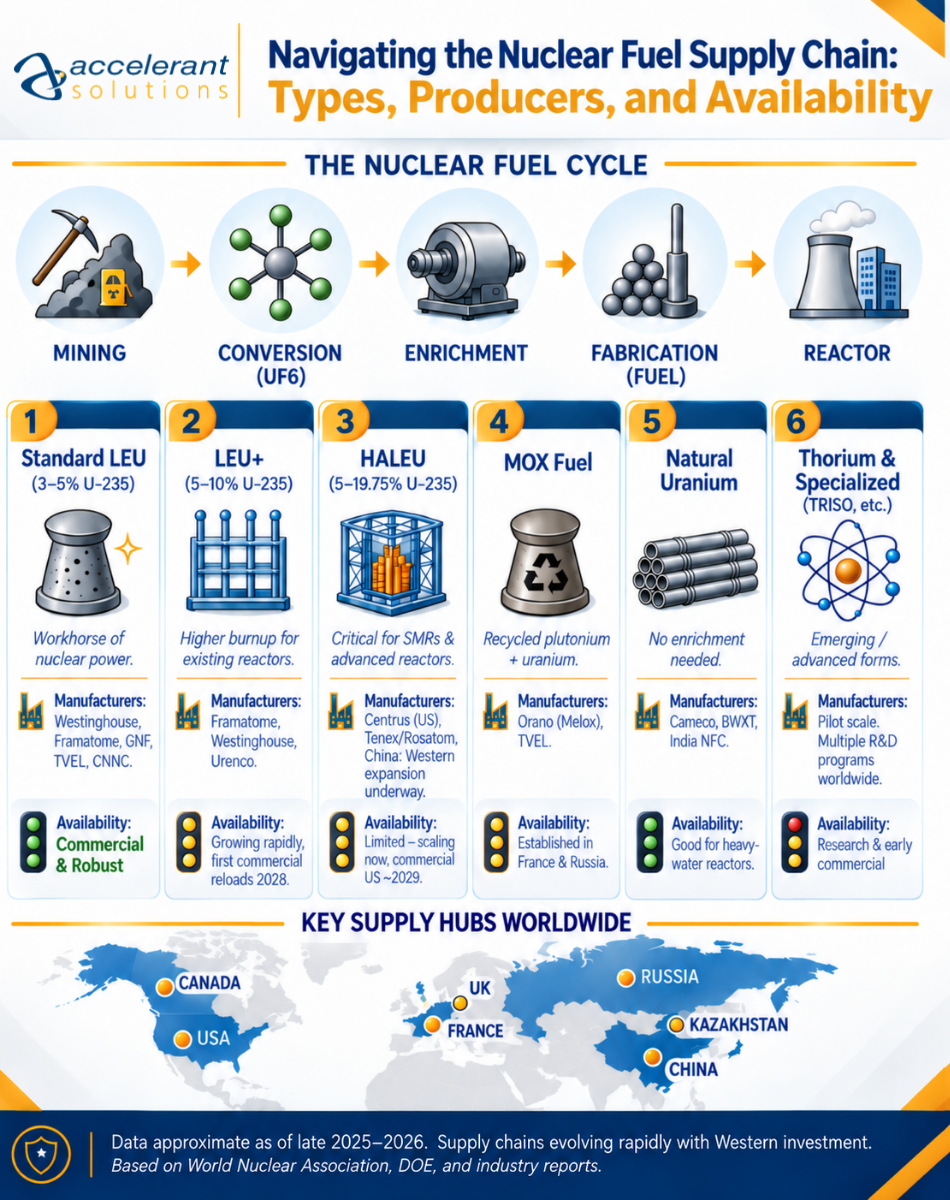
Navigating the Nuclear Fuel Supply Chain: Types, Producers, and Availability
As nuclear energy gains momentum worldwide, one critical question is becoming increasingly important: Can the nuclear fuel supply chain keep pace with growing demand?
While conventional reactors rely on an established global fuel market, emerging technologies are introducing new requirements for fuel production, enrichment, and availability. Understanding these differences is essential as the industry prepares for new reactor deployments. From traditional uranium fuel to advanced options like HALEU, let’s explore the major nuclear fuel types, their producers, and the supply challenges shaping the industry’s future.
1. Low-Enriched Uranium (LEU) Oxide Fuel – The Global Standard
Most of the world’s roughly 440 operating power reactors use UO₂ pellets enriched to 3–5% U-235. Natural uranium is only about 0.7% U-235. Consequently, enrichment raises the fissile content so reactors can sustain a chain reaction efficiently.
Key steps and major players:
-
Mining: Kazakhstan (Kazatomprom) dominates global supply. Canada (Cameco) and Australia also contribute significantly.
-
Conversion: Cameco (Canada), Orano (France), and Rosatom (Russia) lead this step. Currently, US capacity is limited but restarting.
-
Enrichment: Urenco (Europe/US) and Orano (France) are major players. Historically, Rosatom (Russia) held a large share. However, US commercial capacity is growing via Urenco USA.
-
Fabrication: Westinghouse, Framatome, and Global Nuclear Fuel (GNF) are key fabricators. Moreover, TVEL (Rosatom) and CNNC (China) play major roles.
Availability: Standard LEU benefits from an established global supply chain. However, geopolitical pressures and anticipated reactor growth are increasing the focus on domestic production and supply diversification. While existing infrastructure supports today’s reactor fleet, expanding capacity will be important to meet future demand.
2. LEU+ (Higher-Enriched LEU, typically 5 – 10% U – 235)
As reactor operators look to improve fuel efficiency and extend operating cycles, LEU+ is gaining attention as an evolution of conventional uranium fuel. With enrichment levels typically between 5% and 10% U-235, LEU+ offers opportunities for higher burnup and improved reactor economics. Recently, Framatome signed the first commercial contract for a reload above the traditional 5% limit. Meanwhile, Westinghouse is also advancing higher-enrichment options.
Availability: This market is expanding rapidly under regulatory approvals. Therefore, it is still limited in volume today but far more accessible than full HALEU. It leverages existing infrastructure with modifications.
3. High-Assay Low-Enriched Uranium (HALEU) – 5-19.75% U-235
While LEU+ builds on established reactor technology, HALEU introduces a different challenge for the nuclear fuel supply chain: developing sufficient production capacity to support emerging reactor designs.
Many advanced reactors, including certain small modular reactors and microreactors, depend on HALEU to achieve more compact cores and longer operating cycles. However, commercial supply remains limited, making fuel availability an important consideration for developers planning future deployments.
Producers and status:
-
Russia and China have had the only commercial-scale capability.
-
Currently, the United States is developing capacity. Centrus Energy’s pilot cascade has produced over 900 kg of HALEU. Commercial expansion is funded and targets roughly 12 t/year initially.
-
Europe and the UK are also expanding capabilities.
-
Fabrication of HALEU fuels is advancing at sites like BWXT and X-energy.
Availability: HALEU is currently constrained. Commercial Western supply is nascent. As a result, this remains the biggest near-term bottleneck in the nuclear fuel supply chain for many advanced reactor deployments.
4. Mixed Oxide (MOX) Fuel
MOX fuel blends plutonium oxide with uranium oxide. It is used in some light-water reactors (notably France) and fast reactors.
Main producers: Orano’s Melox plant in France is the primary industrial-scale facility. Meanwhile, Russia produces MOX for its BN-800 fast reactor.
Availability: It is established in closed-fuel-cycle countries like France and Russia. However, it is not widely available commercially elsewhere due to reprocessing requirements and economics.
5. Natural Uranium Fuel
Heavy-water reactors (CANDU/PHWR) and some older designs use natural uranium fuel. Therefore, no enrichment is required. Fabricators include Cameco and BWXT. Supply is straightforward via the same mining and conversion path.
6. Thorium-Based Fuels (Emerging)
Thorium-232 is fertile and can breed U-233. India has long-term plans centered on thorium. Furthermore, China and others have experimental programs. Currently, there is no large commercial supply chain for power reactors, so availability remains research and pilot scale.
7. Specialized Forms (TRISO, Metallic, etc.)
TRISO particles are used for high-temperature gas-cooled reactors. Fabrication is advancing in the US via BWXT and X-energy. Metallic fuels are used for some fast or microreactors. These forms depend heavily on HALEU or specialized LEU supply. Therefore, dedicated fabrication lines are still scaling up.
Summary Snapshot of Availability (2025–2026 view)
| Fuel Type | Enrichment / Form | Main Manufacturers | Current Availability |
|---|---|---|---|
| Standard LEU | 3–5% UO₂ | Westinghouse, Framatome, GNF | Commercial, good |
| LEU+ | 5–10% | Framatome, Westinghouse, Urenco | Growing, first reloads near |
| HALEU | 5–19.75% | Centrus (US), Russia, China | Limited / constrained |
| MOX | Pu + U oxide | Orano (Melox), TVEL | Established in select countries |
| Natural U | 0.7% | Cameco, BWXT | Good for PHWRs |
| Thorium / Advanced | Various | Pilot / national programs | Research & early commercial |
Preparing the Workforce for New Fuel Types
The future of nuclear fuel extends beyond production capacity. As the industry advances LEU+, HALEU, and other specialized fuel forms, utilities and reactor developers must also prepare their teams for evolving operational requirements. New fuel technologies can introduce different considerations for fuel handling, safety, procedures, and personnel qualifications. Addressing these needs early is an important part of operational readiness.
At Accelerant Solutions, we recognize that advancing nuclear technology requires an equally prepared workforce. Through our nuclear training and workforce development capabilities, we help organizations strengthen the knowledge, skills, and operational readiness needed to support an evolving industry.
Explore our nuclear training capabilities.