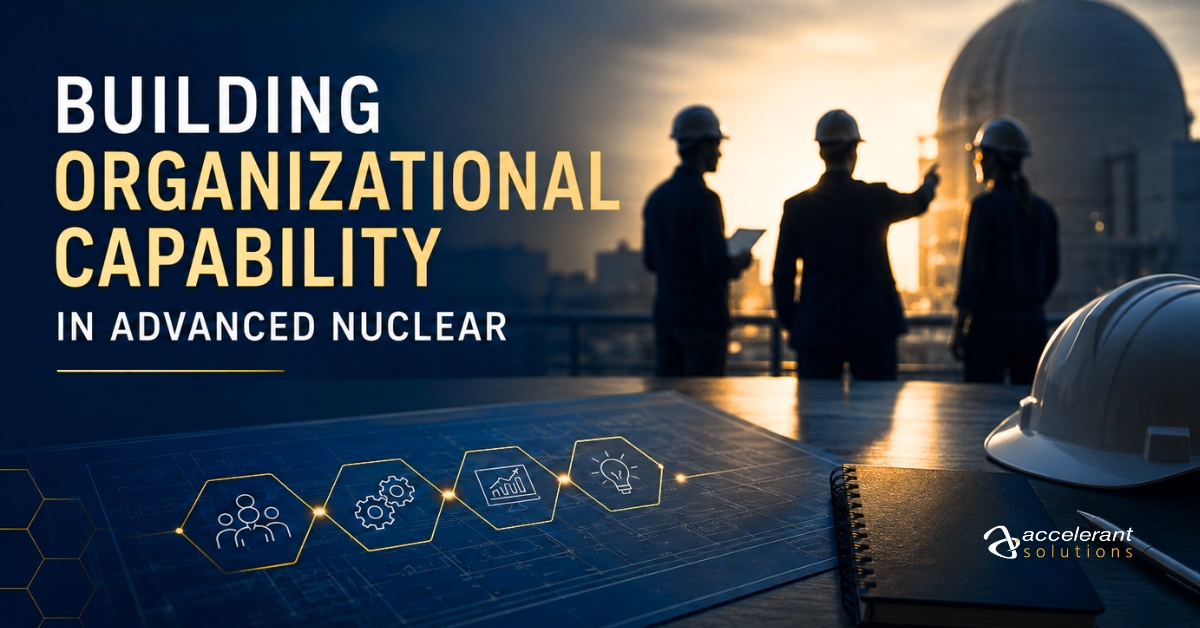
Building Organizational Capability in Advanced Nuclear
Advanced nuclear is often viewed as a technology challenge. In reality, it’s just as much an organizational challenge. The future of advanced nuclear won’t be shaped by reactor technology alone. It will also be shaped by the organizations responsible for bringing that technology to life.
As advanced nuclear companies move from concept through licensing, engineering, construction, and ultimately operations, they’re faced with strategic decisions that extend far beyond reactor design.
Every strategic decision an organization makes ultimately answers one question:
What capabilities are essential for us to own, and where can outside expertise help us move faster without compromising long-term strength?
There isn’t a universal answer. Every organization has different priorities, resources, and long-term objectives. But one trend is becoming increasingly clear: building organizational capability isn’t about doing everything yourself; it’s about intentionally developing the right capabilities at the right time.
At Accelerant Solutions, we’ve had the opportunity to support organizations across multiple stages of the advanced nuclear lifecycle – from workforce development and training to engineering support, quality programs, licensing deliverables, procedure development, and operational readiness. While every organization is different, one recurring theme continues to emerge. Leaders aren’t simply asking how to add more people. They’re asking how to build the capabilities their organizations need to execute with confidence.
Organizational Capability Is More Than Headcount
Organizations don’t become execution-ready because they hire more people. They become execution-ready because they intentionally develop the capabilities needed to execute consistently. In reality, organizational capability is built through the combination of people, processes, systems, experience, and execution. That’s especially true in advanced nuclear.
The challenge isn’t simply building a reactor. It’s building an organization capable of designing, licensing, constructing, operating, and continuously improving one. In our experience, these efforts rarely happen one at a time. They happen all at once.
That overlap creates a different challenge than simply filling open positions. Leaders must decide where institutional knowledge should be developed internally and where experienced specialists can help accelerate progress while strengthening the organization for the long term.
Capability Takes Many Forms
Building organizational capability isn’t limited to hiring engineers or expanding project teams. Capability isn’t a department. It’s the combined strength of people, processes, systems, knowledge, and execution. Depending on where an organization is in its journey, capability may include:
- Developing workforce and training programs
- Strengthening engineering and technical documentation
- Establishing quality assurance and quality control processes
- Supporting licensing and regulatory deliverables
- Preparing for operational readiness
- Improving procedures and knowledge management
- Scaling project execution without sacrificing organizational maturity
Every organization will prioritize these differently, but the objective remains the same: creating the capabilities needed to execute safely, efficiently, and confidently.
Strategic Expertise Should Strengthen, Not Replace, Internal Teams
The conversation shouldn’t be “Should we use external support?” The better question is, “Where does specialized expertise strengthen our organization the most?”
Professionals who have supported commercial nuclear projects, licensing efforts, engineering programs, workforce development initiatives, or operational readiness activities bring more than additional capacity. They bring practical lessons learned, established methodologies, and objective perspectives that help organizations make informed decisions while avoiding unnecessary rework.
When integrated effectively, specialized expertise doesn’t replace internal capability; it helps build it. Knowledge transfer, mentorship, collaborative execution, and process improvement leave organizations stronger than they were before. The goal isn’t to rent expertise. It’s to build it into the organization.
Capability Should Evolve With the Organization
The capabilities required during licensing are different from those needed during detailed engineering, construction, commissioning, or operations. Organizational capability shouldn’t be treated as a hiring plan. It should be treated as a long-term business strategy.
Rather than viewing organizational growth as a one-time hiring initiative, leading organizations are treating capability as a strategic asset, and one that evolves alongside the program itself.
That often means investing internally where long-term ownership is essential while leveraging specialized expertise where it can accelerate execution, reduce risk, and help internal teams mature more quickly.
Looking Beyond Today’s Milestones
Advanced nuclear organizations aren’t just preparing to deliver the next licensing milestone, engineering package, or construction phase. They’re building organizations that will support safe, reliable operations for decades. That requires more than technical excellence. It requires intentional capability development.
At Accelerant Solutions, we’ve observed that building organizational capability is an ongoing strategic investment and not a one-time staffing exercise. Whether the challenge is workforce development, engineering support, quality programs, operational readiness, licensing deliverables, or knowledge transfer, organizations that intentionally strengthen these capabilities today will be better positioned for tomorrow.
Technology may launch the next generation of reactors. Organizational capability will determine who successfully delivers them. The organizations that thrive won’t necessarily be the ones that do everything themselves. They’ll be the ones that know what they must own, what they should develop, and when the right expertise can help them move forward.
How is your organization approaching capability development as advanced nuclear continues to evolve? We’d love to hear your perspective.